Employers providing IVF as a progressive employee benefit have been urged to rethink their approach and embrace more preventative solutions to help women avoid having to have IVF where possible.
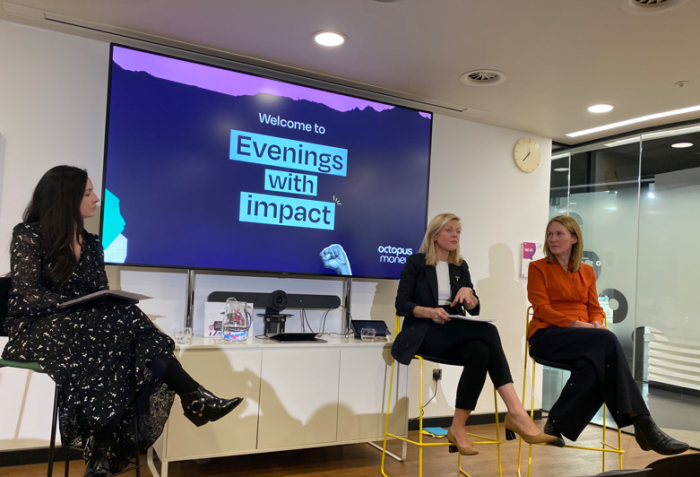
Deirdre O’Neill, CEO at Hertility (pictured centre), said: “Currently, what we’re seeing is an approach that says, ‘Hey, it’s okay, we’ll pay for you to freeze your eggs’. But for the companies that are trying to say, ‘We’re super progressive, we’ll pay for you to have IVF, we’ll pay for you to freeze your eggs’, in my mind, that’s kind of morally bankrupt. It says to someone, ‘just keep working through your fertile years, and we’ll deal with the problem’.”
She explained that when you consider the physiological, psychological and hormonal challenges that are introduced by having to have IVF, it is something people should avoid.
“We shouldn’t be saying, ‘hey, we’ll pay for you to have IVF’. We should be saying, we’ll pay to prevent you ever needing to have IVF, if you can at all avoid it. I think that is really important within a workplace context.”
O’Neill was speaking at the ‘Women in the Workplace: Financial wellbeing, fertility and mental health’ event, hosted by financial wellbeing provider Octopus Money.
She stressed that the current healthcare system is really reactive to illness, but her firm Hertility, which provides advanced testing for fertility and menopause, was trying to encourage a proactive approach to wellness instead.
“We really want to shift that narrative, particularly within the workplace, because there’s so much that can be done [around fertility] if you know in advance. And I think changing the mindset of things to a preventative, personalised perspective is really what we sought to achieve at Hertility.”
The firm helps women understand what their reproductive capacity is, which enables them to plan for the future.
O’Neill added: “We plan our spending based on our bank reserve, but we don’t seem to plan our families based on our ovarian reserve, and that’s something that seems to be at a total disconnect.

“Why wouldn’t we say, ‘Okay, what have I got in the [fertility] bank? Have I got years to play with, have I not? Do I need to plan? Do I need to freeze [my eggs]? Do I need to have preventative solutions?’.”
‘Benefits halo’
Event speaker Ruth Handcock, CEO at Octopus Money (pictured right), was asked whether it was fair to offer benefits that aren’t accessible to all, such as fertility support.
She said that benefits work on two axes: the extent to which a benefit helps the majority of your employees; and the emotional impact of that benefit.
Benefits with really low emotional impact that are not relevant to the majority of your employees “aren’t worth bothering with”, while products and services that are really emotionally impactful and widely applicable is where she puts her money.
However, there are certain benefits that will have a huge emotional impact on your employees, but might only help a minority of people, Handcock said.
“Just because they only help a minority of people doesn’t mean that the halo of that benefit doesn’t reach much wider.
“Benefits like this can reach more widely because of the cultural impact of people seeing their peers being supported in something that they’re finding stressful or distracting or keeping them away from work and keeping them away from being productive. These benefits can have such a deep impact on that individual that the impact on your employee brand is great.”
Handcock gave the example of speaking to employees over the years who have suffered a bereavement. She said that their manager had said: “Don’t even think about coming to work, take as much time as you need and everything is covered.”
As recently as 15 to 20 years ago, this kind of response from a manager or senior colleague was not typical, she stressed, however, the benefit of acting differently and treating someone with extreme humanity is huge.
“It may only be one employee in a year that has this situation, but the loyalty and the feeling that creates is so great that I would say it’s actually as impactful as having a benefit that was really widely applicable.”
Handcock said that once you think about benefits in that way, you’re no longer in the conversation of whether it is fair.
“Fairness isn’t the same as everyone getting access to the same thing, and you’ve got to let go of that, but it allows you to have that conversation about what’s impactful, what makes your employment feel like being part of a family rather than a transactional employee that just gets paid and goes home. It allows you to shift the conversation on,” she said.
The discussion was chaired by Kathryn Neale, senior project director: head of culture, talent, development and ED&I at BBC news (pictured left).