
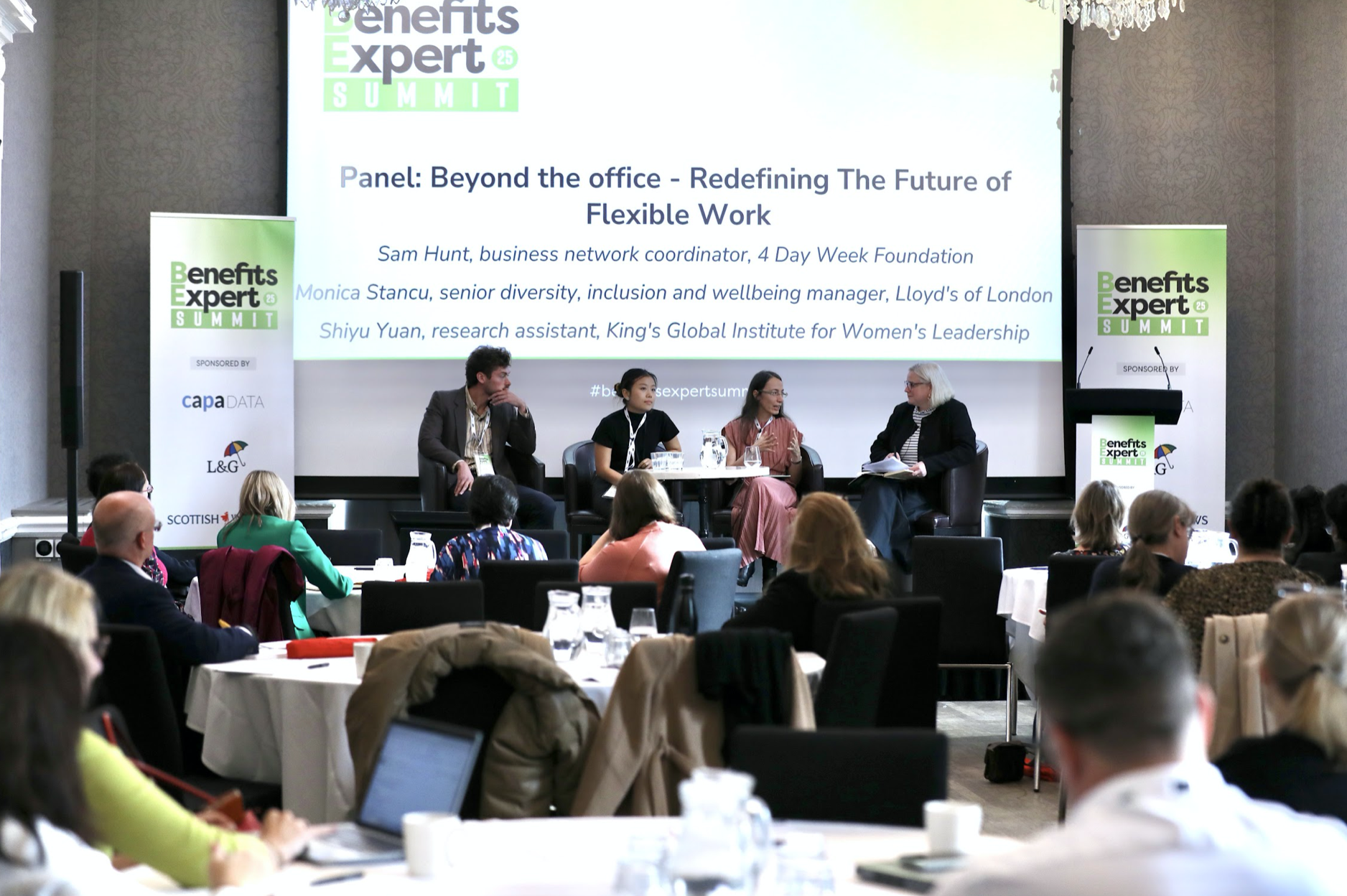
Flexible working is now a core feature of modern employment, but its success depends on trust, consulting employees and a “focus on output rather than presence”.
Speaking at a panel discussion at the Benefits Expert Summit, 4 Day Week Foundation business network strategist Sam Hunt, Lloyd’s of London senior diversity, inclusion and wellbeing manager Monica Stancu and King’s College London Shiyu Yuan explored how flexible working has become the norm, its benefits for employees and employers and the cultural and leadership changes needed to make it sustainable.
Flexible working is now common in many industries, particularly through hybrid models where employees spend two to three days a week in the office.
Stancu said: “We found that most companies in the market now have adopted a hybrid way of working. Most companies expect people to be in the office about two, three times a week, which I think it’s huge progress, particularly for our industry.”
Employees are increasingly prioritising flexibility over salary, with flexible working also supporting wellbeing, productivity, retention and access to a broader and more diverse talent pool.
Hunt noted: “People would readily accept a lower salary for another job which is more flexible. In the last five years, that balance has shifted dramatically towards people prioritising flexibility.”
Stancu added that flexibility enables employers to reach a wider range of candidates. “I’m the biggest advocate for flexible working because it gives you access to a much wider talent pool. It’s something that is good for the employer and the employee.”
Hunt said the benefits for employers go beyond recruitment. He added: “From an employer’s perspective, if you can cultivate the optimal environment for your employees to work in, they are going to be loyal, they are going to stay at the company longer, they are going to put in more effort, they are going to be more motivated, they are going to be more productive.”
Yuan highlighted that different types of flexibility, such as compressed hours, remote work, or flexible start and end times, can work even in traditionally on-site roles like construction or retail.

She said: “We see some industries that you never expect. A construction company can manage to do more flexible time, even though you have to be on-site.”
Hunt said successful flexible working requires consultation with employees, strong communication, clear, outcomes-focused objectives and cultural shifts to eliminate bias against those using flexible options.
He noted: “The best thing you can do is consult the staff on a regular basis. When it is top down, it does not create the same buy-in.”
Yuan agreed saying workplace culture plays a key role in how flexibility is perceived.
“We see that regardless of the person’s productivity, people tend to assume they are less productive if using flexible working. If we normalise it for everybody, we can see positive outcomes.”
Stancu stressed that focusing on output rather than presence is critical. She also said flexible working can reduce costs, improve efficiency and benefit the environment by cutting office space needs and commuting.
She noted: “A lot of companies are really shiny buildings, but they are very expensive. It is cheaper if it is smaller, because a lot of people are working flexible. So it is good for the environment, less pollution, less space.”
Hunt said that ultimately, flexibility benefits both employers and employees but only if it’s thoughtfully implemented and supported by inclusive policies and leadership commitment.
“It is hard, but I am really impressed just by the companies that come to us and speak about how they can improve their practices. They understand people are human beings, and because they know that, it is feeding the success of their organisation.”
Stancu added: “It is really important to be as creative as possible. Involve people from underrepresented groups to give feedback on your working policies. Decide what is non-negotiable and what is negotiable.”